
Propane / Heating Oil / HVAC Services
- My Account:
- Sign In
- Register
- Make Payment
-
Oil & Propane
Oil & Propane
-
- Become an oil customer overview
- Become an oil customer
- Heating oil services
- Heating oil delivery services
- Propane services
- Propane equipment
- Bioheat fuel
- Emergency weather services
- Pricing and payment plans
- Service and protection plans
- Equipment
- Special offers
- Heating oil FAQs
- Propane FAQs
- Bioheat FAQs
- Seasonal offers
- Heating oil special offers
- Propane special offers
- Heating equipment special offers
- Featured articles
- Choosing a heating oil provider based on pricing, service plans and support
- Propane vs Electric Heat: pros and cons
- How does oil heat work?
- Benefits of propane heat
- Heating oil vs natural gas heat
- How to save on heating oil and manage your bill
- Home heating oil is a great value
-
-
Heating
Heating
-
- HVAC services overview
- HVAC services
- Heating Systems
- Tank & Tankless Hot Water Heater Services
- HVAC home system accessories
- HVAC filter replacements
- Natural gas services
- Boiler and furnace repair
- Service plans
- Special offers
- Oil to gas conversions
- Emergency boiler and furnace services
- Heating FAQs
- HVAC FAQs
- Seasonal offers
- Heating system special offers
- Featured articles
- HVAC Split System vs Packaged Unit
- Tankless water heater vs tank storage water heater
- Why does my furnace keep turning on and off?
- Difference between boiler vs furnace
- When to replace furnace vs repair furnace
- Heating system tune up tips
- How to choose a tankless water heater
- Radiator vs baseboard heating
- How often to replace water heater
-
-
AC
AC
-
- HVAC services overview
- HVAC services
- Air conditioning services
- AC systems
- Ductless AC and mini-split
- HVAC home system accessories
- HVAC filter replacements
- AC tune-ups
- Air Conditioning Service Plans
- Emergency AC repairs
- AC replacement
- AC special offers
- AC FAQs
- Seasonal offers
- Cooling system tune up special offers
- Cooling system equipment offers
- Featured articles
- Why you should switch to a new energy-efficient air conditioning system
- How often you should change the AC filters in your house and how to do it
- What is a ductless mini-split AC system
- What size of central air conditioner do you need
- Heat pumps vs. air conditioners: What's the difference and which should I get
- Time to replace your AC?
- Choosing the best home air conditioner
- AC maintenance guide
-
- Generators Generators
-
Customer Hub
Customer Hub
-
- My Account overview
- My Account
- Paying your bill
- SmartPay
- Schedule an appointment
- Emergency services
- Service plans
- Referral Rewards
- Customer FAQs
- Featured articles
- Pay your bill online
- Automatic delivery facts you need to know
- Answers to most commonly asked questions
- Scheduling through My Account
- Enroll now
Control you want. Convenience you need.
Do it all quickly and easily online with My Account!
-



SEER Ratings Explained: What Counts as a Good Rating
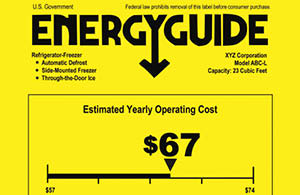
When you shop for a new air conditioner, one number does most of the talking: the Seasonal Energy Efficiency Ratio (SEER) rating. It is the figure on the bright-yellow energy label, the spec your contractor quotes, and the lever that most directly controls how much you will pay to run the system every summer for the next decade and a half. The rating system also changed in 2023, which is why you will now see two numbers, SEER and SEER2, and why some older guidance no longer applies. This guide from your local HVAC pros explains what the number means, what counts as a good one where you live, and how to weigh it when it is time to replace.
How SEER actually measures efficiency.

SEER is the total cooling an air conditioner provides over a typical cooling season divided by the total electricity it uses over that same period, expressed as a single number. The cooling output is measured in BTUs and the electricity in watt-hours, and the ratio collapses a season of varied conditions into one comparable figure.
The “seasonal” part matters. SEER does not describe performance at one fixed temperature; it averages across the range of conditions a system sees over months of operation, which is why it predicts real-world running cost better than a single-point measurement would. A system rated at a higher SEER converts more of the electricity you pay for into actual cooling, and wastes less as heat and inefficiency.
Practically, the number behaves like miles per gallon for your air conditioner. A higher SEER is the more fuel-efficient system: it does the same cooling job using less electricity, so the savings show up on every summer bill for as long as you own it.
Why you now see two numbers: SEER vs. SEER2.
SEER2 is the updated federal efficiency metric that replaced SEER for regulatory purposes on January 1, 2023, using a more demanding test procedure that better reflects real installed conditions. The change was not cosmetic. The new test raises the external static pressure equipment must work against during evaluation, simulating the ductwork resistance a system actually faces in a home rather than the gentler lab conditions of the old test.
Because the test is harder, the same physical unit earns a slightly lower number under SEER2 ratings than it did under SEER. The shift is roughly 4 to 5 percent, so a unit that was 16 SEER lands near 15.2 SEER2. Nothing about the machine changed; only the yardstick did. SEER is now retained mainly for historical comparison, while SEER2 is the figure that governs what can legally be sold and installed.
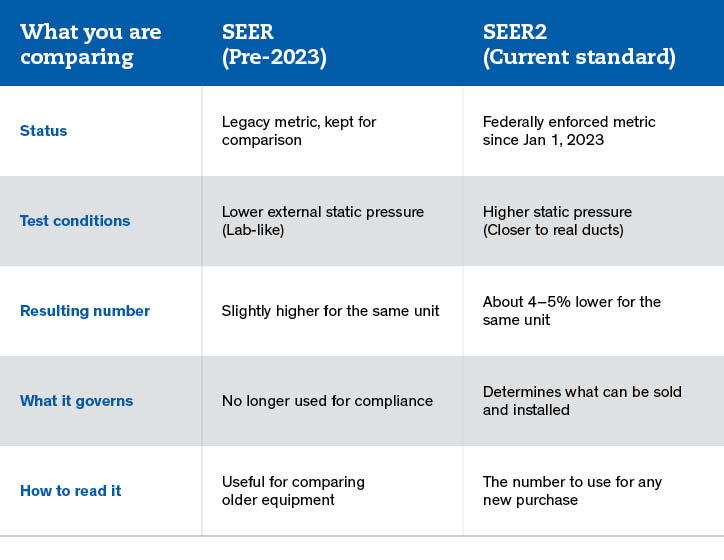
The takeaway when shopping: compare SEER to SEER2. Putting an old SEER number next to a new SEER2 number makes the newer unit look worse than it is, because you are comparing scores from two different tests.
What counts as a good SEER rating?
A good SEER rating is any figure comfortably above your region’s federal minimum, with the right target rising as your cooling usage and electricity costs rise. There is no single “good” number that applies everywhere, because the federal standard itself differs by climate region and the payoff from higher efficiency depends on how hard you run the system.*
Federal minimums are set by region, and verifying the current figure for your area is the necessary first step before judging any rating. As of the 2023 SEER2 standards, the North region minimum for a split-system central AC is 13.4 SEER2 (about 14 SEER), while the warmer Southeast (which includes Delaware and Maryland) and Southwest regions require higher minimums, generally 14.3 SEER2 (about 15 SEER) for smaller systems. Because Petro serves the Northeast, the
North-region minimum is the relevant floor for most Petro customers.
- At the minimum (13.4, roughly–14 SEER2): the lowest upfront cost, sensible for homes with light cooling use or short expected ownership.
- Mid-tier (about 15–17 SEER2): the sweet spot for most households, where the energy savings reliably justify the modest price step up over many summers.
- High-efficiency (18+ SEER2): worth it for heavy cooling climates, high electricity rates, or homeowners staying long enough to bank years of savings, often paired with variable-speed comfort features.
Balancing efficiency against upfront cost.
The correct SEER2 rating for your home is the one where the lifetime energy savings outweigh the higher purchase price, not simply the highest number on the showroom floor. Efficiency is not free: each step up the SEER2 ladder adds to the equipment cost, and beyond a point the additional savings shrink while the price keeps climbing.
Three factors decide where your break-even sits. The first is how much you run cooling, since a system used heavily recovers its efficiency premium faster than one used a few weeks a year. The second is your local electricity rate, because the same efficiency gain is worth more where power costs more. The third is how long you will own the home, as savings accrue over years and a longer horizon justifies a higher tier.
A proper assessment weighs all three against your home’s specifics, which is what a replacement consultation is for: matching the efficiency tier to your actual usage rather than to a generic recommendation. For a closer look at the payback side of that decision, see our guide to switching to a new energy-efficient AC.
How equipment type changes the SEER conversation.
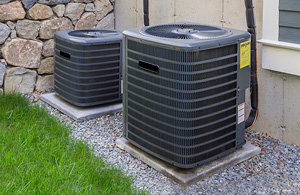
SEER2 ratings apply across central, packaged, and ductless systems, but the practical efficiency ceiling and the value of high ratings differ by equipment type. Knowing which system you are specifying changes how high a rating is realistically available and worthwhile.
High-efficiency central systems, such as the TraneⓇ air conditioning systems Petro installs, reach well into the high-SEER2 range when paired with variable-speed compressors, which also improve humidity control and comfort beyond the raw efficiency number.
Ductless mini-split systems frequently post some of the highest SEER2 ratings available, and because a ductless mini-split avoids the duct losses built into the SEER2 test, it can be the most efficient route for additions, conversions, or homes without existing ductwork.
The point is that the “good rating” target is not one-size-fits-all across equipment. A mid-tier ducted system and a high-tier ductless unit can both be the right efficiency choice depending on the home.
When to bring in a Petro technician.
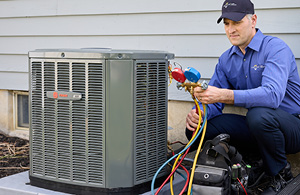 A professional consultation is the right move whenever you are deciding on efficiency level, replacing an aging system, or trying to reconcile the SEER and SEER2 numbers on competing quotes. Three situations make that call clearly worthwhile.
When your current system is 10 or more years old.
An air conditioner installed before the SEER2 transition is almost certainly less efficient than today’s minimum, and likely far below it if it is a decade old. A technician
can measure what you have, estimate its true running efficiency, and show you what a modern system would save, turning an abstract SEER number into a real annual figure for your home.
When you are comparing quotes with mismatched numbers.
If one quote lists SEER and another lists SEER2, you are not comparing like with like, and the gap can mislead you into the wrong choice. A Petro technician can normalize the
numbers, explain what each system actually delivers, and make sure the comparison is honest before you commit to a new AC system.
When you want the efficiency tier matched to your usage.
Choosing between a mid-tier and a high-efficiency system is a judgment about your climate, rates, and how long you will stay, not a number you can pull from an article. An
in-home assessment is the only way to make that decision accurately, and it is the step that prevents both overpaying for efficiency you will not use and underbuying and regretting it on summer bills.
Find the right efficiency level for your home before you buy. Get a free quote from your local HVAC pros at Petro for a system sized and rated to your home’s actual cooling needs.
Related guide
AC service plan benefits: Is an annual plan worth it? — once your system is installed, a service plan keeps it at the efficiency you paid for. See what an annual plan covers and when it pays for itself.
*Minimum efficiency requirements per U.S. Department of Energy, 10 CFR 430.32(c). SEER-to-SEER2 equivalences per the Air-Conditioning, Heating, and Refrigeration Institute. Requirements vary by DOE climate region; confirm the applicable standard for your location before purchase.